

Countless businesses and organizations use legal electronic signatures to speed up their document workflows, but are they actually compliant and valid?
This is one of the most common concerns among compliance-conscious decision-makers, and for good reason. Laws vary across jurisdictions, not every document type qualifies, and the technical requirements for a signature to be legally binding aren’t always obvious.
The legal framework, however, is more mature than most people realize. Across the US, the EU, and most major economies, legislation explicitly recognizes electronic signatures as enforceable, provided they meet specific conditions. Platforms like SignWell are built precisely to meet those conditions.
This article covers the regulatory frameworks governing eSignatures globally, the requirements a signature must meet to be legally valid, and how SignWell helps you sign with confidence and in full compliance.
Creating Legal Electronic Signatures Across the Globe
Electronic signature laws aren’t universal. While the core principle (that a digital signature can carry the same legal weight as a handwritten one) is widely accepted, the specific eSignature compliance rules vary by region and, in some cases, by state or document type. Here’s what you need to know about the major frameworks.
United States
The US operates under two complementary pieces of legislation that together establish the legal foundation for digital signatures nationwide.
The ESIGN Act of 2000 (Electronic Signatures in Global and National Commerce Act) is a federal law that gives electronic signatures the same legal standing as handwritten ones for transactions that affect interstate or foreign commerce.
ESIGN establishes that a signature cannot be denied legal effect solely because it is in electronic form. It also sets baseline requirements around consumer consent and record retention.
The UETA (Uniform Electronic Transactions Act) was adopted in 1999 and enacted by 49 states, along with the District of Columbia, Puerto Rico, and the U.S. Virgin Islands.
The UETA complements the ESIGN Act at the state level. Where ESIGN is the federal backstop, UETA governs the validity of electronic records and signatures in state-level transactions.
Slight Differences by State
Illinois adopted UETA in 2021, but also maintains its own Electronic Commerce Security Act (ECSA) from 1998. The ECSA distinguishes between standard electronic signatures and secure electronic signatures, which carry greater evidentiary weight.
Washington adopted UETA in 2020, replacing its earlier digital signature statute. However, the state’s prior legislation shaped certain industry-specific practices (particularly around real estate and notarization) that may still be reflected in local workflows.
New York is the only state that has never adopted UETA. Instead, it relies on the Electronic Signatures and Records Act (ESRA), which establishes the legal equivalence of electronic and handwritten signatures. For practical purposes, ESRA achieves a similar outcome to UETA, but businesses operating in New York should confirm their eSignature platform is compliant.
European Union Law
For businesses operating in Europe or entering into contracts with European parties, the governing framework is eIDAS. This is EU Regulation 910/2014 on electronic identification, authentication, and trust services.
eIDAS was adopted to replace a patchwork of older directives. It standardizes the rules for electronic signatures across all EU member states, creating a single, interoperable framework for the region.
eIDAS defines three tiers of electronic signature, each with a different level of legal weight and technical requirement.
- A Simple Electronic Signature (SES) covers basic digital acknowledgments.
- An Advanced Electronic Signature (AES) must be uniquely linked to the signer. It must be capable of identifying them and be created using data under their sole control.
- A Qualified Electronic Signature (QES) meets the highest standard, meaning it’s legally equivalent to a handwritten signature across all member states. It requires a qualified certificate issued by an accredited trust service provider.
For most business contracts, an Advanced Electronic Signature is sufficient. QES is typically reserved for high-stakes legal and regulatory contexts.
Secure eSignatures with SignWell adhere to all eIDAS requirements. Documents created and signed through the platform meet the appropriate standard for European users and international agreements involving EU parties.
What is Considered a Legally Valid Electronic Signature?
A common misconception is that eSignatures for legal documents occupy a gray area. Some worry that a judge might discount them or that they’re somehow less authoritative than a wet-ink signature.
In practice, the opposite is usually true. A properly executed electronic signature generates a level of documented evidence that a handwritten signature simply cannot match.
Let’s look at what makes an electronic signature legally valid and why the evidence trail is actually an asset in any dispute.
Intent and Consent
The most fundamental requirement is that the signer demonstrably intended to sign and consented to do so electronically. This is the core principle underlying both the ESIGN Act and eIDAS.
A signature executed under pressure, without clear consent to the electronic process, or on behalf of someone without authorization, can be challenged regardless of the technology behind it. Reputable platforms capture this consent explicitly through a disclosure acknowledged before signing begins.
Audit Trails
An audit trail creates a timestamped, tamper-resistant record of every action taken throughout the signing process. This is something a paper document cannot provide. It answers the questions a court will ask: who signed, when, where, and how.
- Timestamps record exactly when each party signed, are tied to a trusted time source, and are cryptographically verifiable.
- Identity verification logs the method used to confirm each signer in the record.
- Location data, such as IP address and geolocation, also further strengthens the record.
Integrity
Beyond proving who signed and when, a legally valid electronic signature must demonstrate that the document itself hasn’t been altered after execution.
This is where electronic signatures have a clear advantage over paper: the integrity of a digital document can be cryptographically verified, unlike a physical document.
- Tamper-evident seals make any post-execution modification immediately detectable.
- Encryption protects the document in transit and at rest.
- Chain of custody logs every interaction with the document from creation to storage.
- Authentication ensures only authorized parties can access or sign.
Document Retention
Both the ESIGN Act and eIDAS require signed records to be stored in a way that allows accurate reproduction later. A compliant platform keeps completed documents and their full audit trails in durable, accessible storage.
What Falls Outside the Scope
While eSignatures are generally accepted wherever handwritten signatures are accepted, there are exceptions in certain jurisdictions. Some documents may still require a handwritten signature, so it is important to verify with a lawyer.
A compliant platform will not attempt to process document types that fall outside the permitted scope.
3 Examples of Legal Electronic Signatures
What do legal electronic signatures look like? The examples below from SignWell’s document workflows show the legal documents that follow eSignature best practices.
Multi-Party Contract
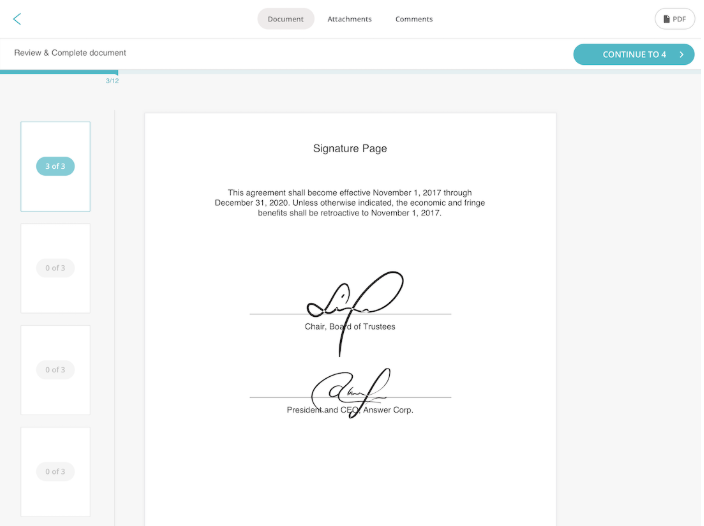
When multiple parties sign the same document, each signature is captured independently with its own timestamp and identity verification record. This example shows how SignWell handles multiple signatures.
Tamper-Evident Seal
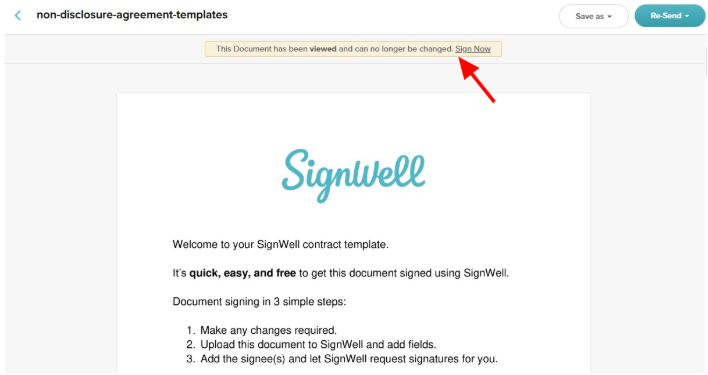
Once the document has been viewed, SignWell cryptographically seals it. Any attempt to alter the content after this point is prohibited.
Full Audit Trail
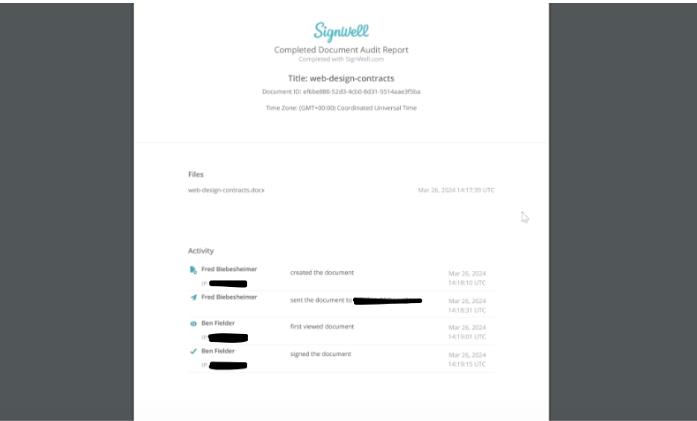
This example shows the audit trail that’s included with each signed document. Note the activity log that tracks the time of every action and who completed it. This creates an evidentiary record that would hold up in any commercial dispute.
3 Specific Industry Compliance Rules for Electronic Signatures
Certain industries operate under additional regulations that impose stricter requirements. Choosing a platform that meets both general and industry-specific standards is smart.
1. Healthcare (HIPAA)
Medical providers and their partners that handle electronic records must comply with HIPAA, which governs how Protected Health Information (PHI) is stored, transmitted, and accessed.
An electronic signature platform used in a healthcare context must comply with the administrative, physical, and technical safeguards required by HIPAA.
SignWell is HIPAA-compliant, meaning it protects PHI throughout the signing process and meets the safeguards required to use it in patient-facing and internal workflows.
2. Life Sciences (21 CFR Part 11)
Organizations that develop, manufacture, or submit data to the FDA must comply with 21 CFR Part 11, the FDA’s regulation governing electronic records and signatures. This framework sets requirements around signature authenticity, record integrity, and system controls.
SignWell supports 21 CFR Part 11 compliance through tamper-evident audit trails, passcode-based authentication, and automatic session lockouts.
3. International Business (Mexico)
NOM-151 is the standard for businesses operating in Mexico or executing contracts with Mexican parties. It establishes requirements for preserving electronic documents and data messages, as well as proving that a file has not been altered since its creation.
SignWell supports NOM-151 compliance through certificates that provide cryptographic proof of document integrity.
How to Create Fully Legal Electronic Signatures
Knowing the rules is only half the equation. How you create electronic signatures in practice determines whether they’ll hold up when it matters. Here are the key best practices to follow.
1. Choose a Compliant Platform
A signature image pasted into a PDF offers no audit trail, identity verification, or legal standing under ESIGN, UETA, or eIDAS. A compliant eSignature platform integrates all of these requirements into the process by capturing consent, logging actions, and cryptographically sealing the document.
When you evaluate a provider, it’s critical that you confirm it explicitly supports the regulations of your jurisdiction and industry. It also helps to choose a platform with an API for legal eSignatures so you can integrate it with your current tech stack.
2. Verify Signer Identity
A signature is only as strong as the proof that the right person made it. You’ll need to verify the signer’s identity, at a minimum, with email verification.
For higher-stakes documents, SignWell supports multi-factor authentication (MFA), which requires signers to confirm their identity through a second channel. The method used is logged in the audit trail, so there’s a clear evidentiary record.
3. Keep Records of Every Document
Retention is a legal requirement under both the ESIGN Act and eIDAS. SignWell generates a full audit report for every completed document, detailing who received it, when they viewed it, and when they signed. This record is your first line of defense in any dispute and should be stored alongside the signed document for the duration of its relevance.
4. Know What You Can and Can’t Sign Electronically
Most everyday business documents (NDAs, service agreements, sales contracts, offer letters, vendor agreements, etc.) are well within the scope of electronic execution.
However, certain document categories are explicitly excluded from eSignature laws in many jurisdictions. When in doubt about a specific document type, consult legal counsel before proceeding electronically.
Count on SignWell for Legally Binding Signatures
Electronic signature law is complex, but executing a compliant document doesn’t have to be. The right platform handles the technical requirements automatically, so you don’t have to think about them.
SignWell meets the standards that matter: ESIGN Act and UETA for US transactions, eIDAS for European agreements, HIPAA for healthcare, 21 CFR Part 11 for life sciences, and NOM-151 for Mexico. Every document comes with a complete audit trail, tamper-evident seals, and authenticated identity records built in.
Ready to sign with confidence? Try SignWell free today.